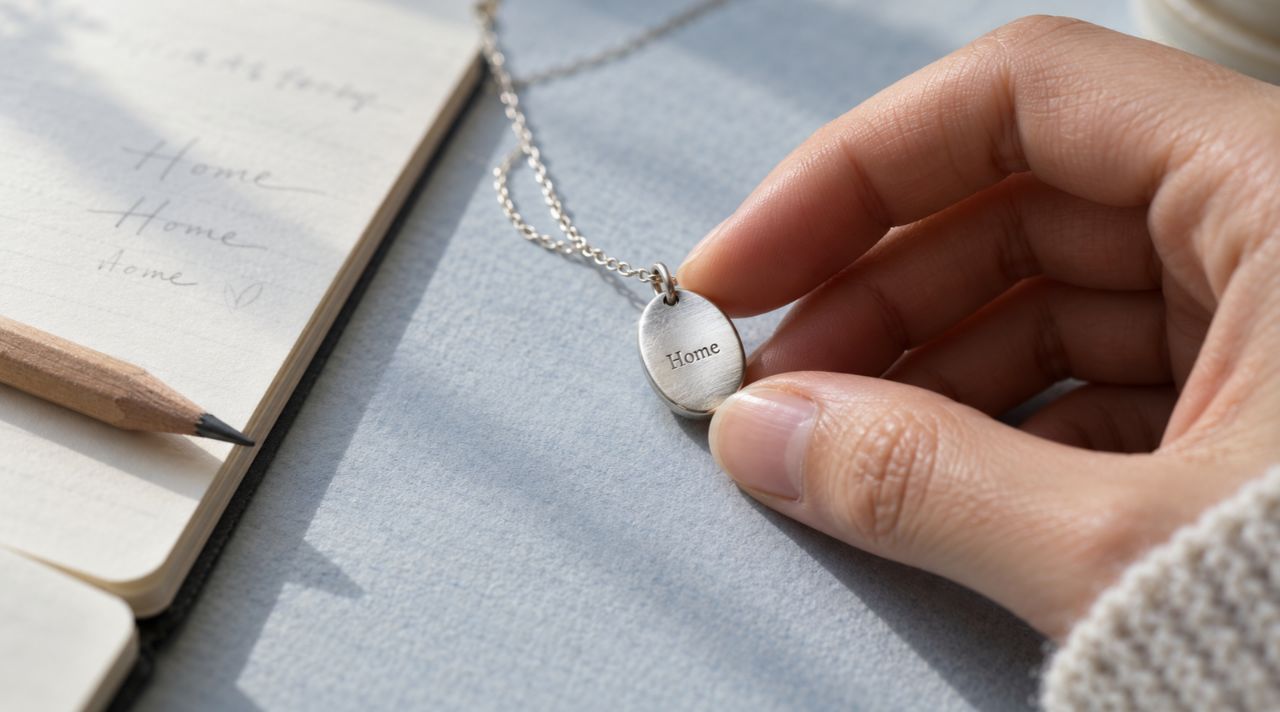

Short engraving ideas work best when they sound like words you would actually say. A familiar sign-off, a shared place, or a simple “Love you” can suit a small gift better than a longer declaration that feels borrowed.
The difficulty is choosing a line that belongs to the relationship and still reads clearly on the object. A message can fit the order form but feel too intimate on a visible bracelet. A date can save space but mean little if it marks an occasion the recipient does not value.
Start with the examples below, then change one detail to make the wording yours. The character counts include spaces and punctuation in each example, but not the surrounding quotation marks. They are a starting point for checking fit, not a promise that any maker can engrave the line on any item.
Before ordering, confirm the available area, supported characters, and final layout. Keep the short message on the gift and give the longer explanation room in a card.
Start with a short line you would actually say
Choose the feeling before choosing the phrase. Affection, friendship, encouragement, and a shared memory do different jobs; you do not need to fit them all into one inscription.
For affection: “Love you” or “So glad it’s you”
A familiar phrase does not become less sincere because it is common. If you normally say “Love you,” adding more elaborate language may make the message sound less like you. Keep the degree of commitment consistent with the relationship you actually share.
- Glad we met 11 characters. A friendly line that can suit a relatively new friendship.
- Same team 9 characters. Best when this is a real expression of mutual support.
- Tea again soon 14 characters. An everyday invitation for someone who shares that habit.
- Save me a seat 14 characters. Gently playful when it recalls something you do together.
For a funny line, start with humor the recipient already enjoys. A joke about being late or losing things may be affectionate between some friends and embarrassing for others, especially on an object used around colleagues.
For encouragement: “I’m here” or “Take your time”
Encouragement should not become a permanent instruction to feel better or work harder. Avoid selecting a phrase that defines someone by a difficult period they may prefer to keep private.
If you are unsure, a note lets you offer support without attaching the words to something they carry.
For a shared memory: a nickname, date, or place
A private reference does not need to explain itself to strangers, but the recipient should recognize it. The following examples are hypothetical: use the pattern only when you have a real detail of your own.
- Fern – 4 characters
A nickname could be enough if it is a name the recipient likes and still uses.
- Pier 4 – 6 characters
A place name can recall a shared routine when both people actually call it that.
- 14 Sep 2022 – 11 characters
A meaningful date can stand alone. A written month helps distinguish the date format, provided it fits.
Make a familiar phrase personal with one detail
Personal wording usually comes from noticing something specific, not adding more adjectives. Choose one detail the recipient already understands and let it do the work.
Replace generic praise with something you both recognize
Write the longer thought first, then identify its most recognizable part. These hypothetical revisions show the method; they are not claims that a particular phrase is more meaningful to everyone.
The point is not to make the phrase mysterious. A reference contributes to meaningful personalization when the recipient recognizes and welcomes the connection.
If the shorter version loses that connection, keep clearer words instead.
Use initials or a date when a sentence feels forced
Names and initials can be a complete choice. Check the name the recipient prefers, and confirm the monogram order if the letters will be arranged as a styled monogram rather than a simple line of initials.
Choose a date because of what it means to the person, not merely because it is available. Confirm whether you mean the day of a first meeting, an achievement, or an anniversary; then write it in a format they will read correctly.
Place references need the same care. With custom map gifts, a location should reflect a welcome connection; an engraved place name works on the same principle.
A childhood address is not automatically a happy memory, and coordinates are not helpful if they are inaccurate or unrecognizable.
Choose words they will feel comfortable carrying
Read the inscription as something the person may see on an ordinary day. Consider both its message and who else may see it.
Keep private jokes off gifts they would not want to explain
A small inscription inside a ring and a large message across a keyring have different audiences. Ask whether the recipient would be comfortable with the reference being noticed, read aloud, or questioned.
A nickname used at home may feel awkward on a work accessory. If you cannot check without revealing the gift, move the private words to a card or ask whether they would prefer an unmarked item.
Skip promises and teasing that do not fit the relationship
Words such as “forever,” “mine,” or “always here” carry different weight depending on who says them. Choose language that already belongs to the relationship rather than using the engraving to announce a new level of closeness.
Likewise, a teasing phrase should be enjoyable for the recipient, not just funny to the giver. Avoid turning a sensitive habit, private struggle, or disliked label into a permanent joke.
Cut words before making the letters smaller
Once the wording feels right, test whether it can work in the available space. Keeping every word is less useful than keeping the part that can be read and understood.
Keep the meaning; move the explanation to a card
Try removing an opening phrase, an extra adjective, or a repeated idea before abbreviating familiar words. “I will always be on your side” can become “On your side” if that still says what you mean: 29 characters become 12.
Do not shorten a message until it changes its promise. “Here today” and “Always here” do not mean the same thing. If a sentence needs context, let the card carry the explanation rather than forcing cryptic initials onto the gift.
Follow the maker’s character limit, including spaces
There is no universal engraving limit. Frank Darling currently states a 17-character limit including spaces for its ring engraving service.
Nixon’s guide states a 26-character limit for its engraved watches. These are provider-specific examples, not limits for all rings or watches.
Count the exact version you will submit, including punctuation.
Ask how the maker handles line breaks, accented letters, symbols, and special characters; a heart icon or an apostrophe that looks right in your document may not be supported in the chosen process.
Check the actual engraving area and text size
Character count does not tell you the width of the lettering. A line of narrow letters and one with wide capitals can occupy different amounts of space, while a curved surface or existing markings may reduce the usable area.
Ask for the engraving dimensions and a layout preview when available.
View the preview at approximately the finished size as a first check, then ask the maker to confirm legibility; shrinking an image cannot reproduce the depth, finish, or contrast of the actual engraving.
Approve only the wording and layout you have checked
The text entered on the order and the final proof are the versions that matter. Treat approval as a separate check rather than assuming that a correct draft guarantees a correct result.
Confirm names, dates, punctuation, and line breaks
- Exact wording
Compare the submitted text with your final chosen line, including capitals, apostrophes, and punctuation.
Look forThe precise version you intend to give.AvoidAn earlier draft left in the order form. - Names and dates
Check preferred names, initials, the actual occasion date, and the order of day and month against reliable information.
Look forConfirmed information, not a remembered spelling.AvoidAssuming a legal name or anniversary date is the preferred one. - Layout and orientation
Check line breaks, placement, and which way the words face when the item is worn or held.
Look forA layout the maker confirms is possible on this piece.AvoidApproving a large-screen preview without checking the real engraving area.
Verify borrowed quotes and handwriting details
If you use a quotation, check it against the original work or the particular translation you mean.
Avoid relying on an unattributed quote image, and do not present your shortened adaptation as the author’s exact words. Ask the maker about its policies for reproducing supplied text.
For handwriting jewelry, check which strokes and details can remain readable at the finished size.
Ask whether the maker will trace the actual writing, alter it, or substitute a font; those choices can change the detail you wanted to preserve.
Leave the gift unengraved if no line feels right
If each option sounds too formal, too intimate, or difficult to read, you can stop. Leaving the surface plain preserves the recipient’s choice, while a handwritten card gives your longer words room.
Other personalized gifts can reflect a known preference through color, format, or a selected photograph.
An inscription is one way to make a gift personal; it does not have to be the final step on every order.
The most useful short engraving ideas give you a starting point, not a script. Keep the words that fit your relationship, remove what sounds borrowed, and confirm that the final line can be read on the actual gift. If the message needs more space or more certainty, put it in the card instead.