
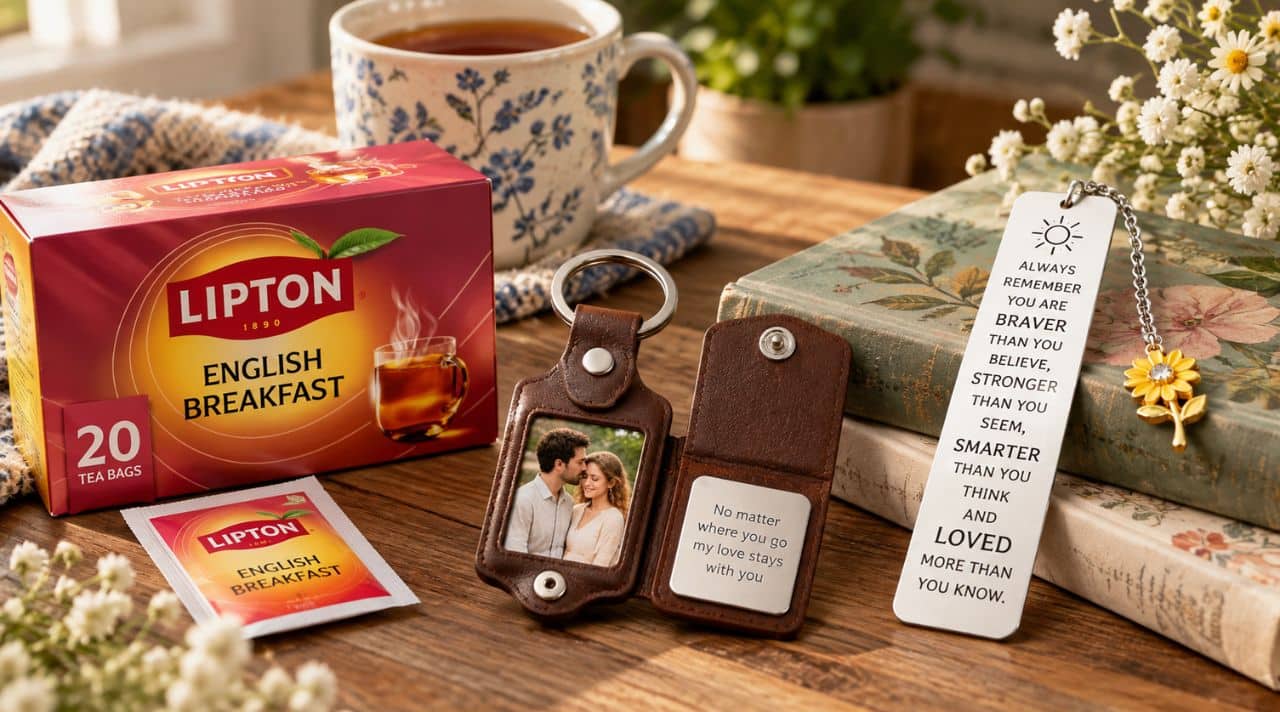

Ten dollars can still buy a thoughtful gift. It just cannot do the thinking for us.
I have bought small gifts simply because they were cute and inexpensive. They looked perfectly giftable in the shop. Then I imagined the person taking them home and wondering where on earth to put them.
That is the trouble with shopping by price alone. A $7 gift is not a bargain if it becomes one more object someone feels guilty about throwing away.
When I look for meaningful gifts under $10, I start somewhere else: what does this person already use, enjoy, carry, eat, read, or remember? A bookmark for someone who always has a paperback nearby makes sense. So does a favorite snack I know they actually like. Sometimes the best answer is a photograph, a handwritten note, or nothing from a store at all.
The budget is small. The reason for choosing the gift does not have to be.
Start with the person, not the $10 limit
Searching for gifts under $10 can get strange very quickly. There are tiny gadgets, miniature signs, joke mugs, keychains with slogans, and objects whose main qualification seems to be that they fit inside a gift bag.
I would rather ask one boring question first: What would this person actually do with it?
- They already do something it fits
A reader uses bookmarks. A tea drinker finishes tea. Someone who writes by hand eventually needs another notebook or pen. I trust an existing habit more than a new habit I have invented for them.
A reason to give itA use I have actually noticedA reason to pauseA use I am imagining - There is a connection they would recognize
A photograph, phrase, recipe, or little keepsake can carry meaning when the recipient knows why I chose it. Personal is not the same as personalized.
A reason to give itA shared memory or known preferenceA reason to pauseSentiment added by the seller - It has somewhere to go
Small does not automatically mean clutter-free. I think about whether the gift will be used up, carried, tucked into a book, or replace something already worn out. That is usually safer than adding another decorative object.
A reason to give itAn obvious place or purposeA reason to pauseOne more thing to store - I would still choose it without the sale price
A low price can make an unnecessary purchase feel sensible. I try to ignore the discount for a moment and ask whether I would still think of this particular person.
A reason to give itThe person came firstA reason to pauseThe bargain came first
If none of those questions produces a good answer, I do not need to force one. There are plenty of meaningful gift ideas for a small budget, including some that do not require buying another object.
Small gifts work best when they fit something already there
I do not think a list of 60 random things becomes more useful just because every item costs less than ten dollars. I would rather narrow the list by the person standing in front of me.
For someone who always has a book nearby
A bookmark is almost laughably simple, which is part of why I like it. For someone who reads physical books, it already has a job waiting for it.

If the printed message does not sound like them, I would skip it. A plain bookmark with one sentence written by me on a card may feel much more personal.
A personalized gift does not become meaningful merely because someone’s name has been printed on it. For me, the useful question is whether the personalization points to something the recipient already cares about.

And if I am unsure about the keychain? I can send or print the photograph and write two sentences about why I chose it. The memory was the gift all along. The hardware was optional.
For someone whose everyday favorite you already know
Some of the best useful gifts under $10 barely look like gift ideas. That does not bother me.
If I know someone drinks the same tea every evening, a small package of that tea has a destination.

The same can be true of a favorite chocolate, the hand cream they already use, a pen they keep borrowing because theirs always disappears, or another small consumable I know they enjoy.
The important words are I know. Food can involve allergies or dietary restrictions. Fragrance is personal. Skin-care products can be even more personal. “Everyone likes this” has led many innocent little gifts into bathroom drawers from which they never returned.
A useful gift does not have to look impressive. Sometimes the safest choice is simply something that already has a place in the recipient’s life.
- Replace rather than add. If something they already use is nearly finished or worn out, a small replacement can make more sense than a novelty item.
- Choose the familiar version. With food, fragrance, or personal-care items, knowing their usual choice matters more than finding an interesting new one.
- Keep the quantity sensible. A small budget is not an invitation to buy a giant multipack simply because the cost per piece looks wonderful.
Cheap but meaningful gifts do not always come from a store
When money is tight, there is an odd temptation to make the gift look bigger than the budget. More pieces. More wrapping. More little fillers.
I would go the other way.
-
A handwritten note about one real thing
Not “You are amazing.” Tell me what I did that made you think so. A remembered detail gives a few lines more weight than expensive stationery ever could.
-
A recipe they once asked you for
Write it properly, including the temperature, quantities, and the little step you normally do without thinking. A family recipe can be useful and personal at the same time when the recipient actually wants it.
-
A photograph with a sentence on the back
Choose the picture for the memory, not because everyone happened to look photogenic. Add the date or a few words about what you remember.
-
A favorite consumable in a small amount
Their usual tea, chocolate, coffee, or another familiar treat can disappear happily instead of requiring permanent shelf space. Check preferences first rather than turning a $6 gift into an experiment.
If even a few dollars are uncomfortable right now, spending less is not a failure of generosity. Small ways to make someone feel remembered can be enough, and sometimes they are more welcome than something bought out of obligation.
What actually makes a cheap gift thoughtful?
For me, the difference is usually one sentence:
That is a much better starting point than: “I needed something under $10, so I bought this.” The recipient never needs to hear either sentence, of course. But I like knowing which one is true.
A bookmark says, “I know you always have a book in your bag.” Their usual tea says, “I remember what you drink.” A photograph says, “I remember this day too.”
None of those connections requires the gift to be expensive. They require attention, which is inconveniently difficult to put in an online shopping filter.
A name, date, or photograph matters only when the recipient welcomes the connection.
I would choose the memory first and the object second.
Even a two-inch object needs somewhere to live if it is meant to be kept.
I prefer something used, consumed, carried for a reason, or easy to put away.
Extra fillers can make the recipient responsible for several things they never wanted.
One thing that fits is enough.
Under $10 means under $10 at checkout
There is one very unromantic part of inexpensive gift shopping: arithmetic.
An item marked $8.99 is not necessarily an under-$10 gift once shipping, tax, personalization, or a required quantity joins the party.
-
Check the exact option you selected
The lowest displayed price may belong to a different size, finish, quantity, or version.
-
Look at the full checkout total
Shipping, tax, and personalization can move an inexpensive item beyond the budget surprisingly quickly.
-
Check the dimensions
Product photos are talented little liars when there is nothing beside an object for scale. Look at the measurements.
-
Check production and delivery time
Personalized gifts may need making time before shipping even begins. If the occasion is close, check the estimated arrival date before becoming emotionally attached to the idea.
-
Look beyond the product description
Buyer photos and independent information can reveal size, finish, or practical problems that polished listing images do not. It is worth taking a moment to check a low-cost online gift before ordering.
If an $8 gift becomes $15 at checkout, I would not stretch the budget just because I had already pictured giving it. There are other gifts.
A few words can keep a small gift from feeling random
I do not think a small gift needs an elaborate explanation. In fact, explaining too much can make a perfectly nice bookmark feel as though it is about to receive a lifetime-achievement award.
One honest sentence is enough.
“I thought of you because you always have a book nearby.”
Or: “I found this photo again and remembered that afternoon.”
The words should be true. That matters more than making them beautiful.
I would also skip the little extras unless they serve a purpose. The miniature ornament tied to the ribbon, the plastic charm inside the bag, the extra trinket added because the gift looked lonely — all of them eventually need somewhere to go.
The gift is allowed to be small.
Meaningful gifts under $10 do not need to compete with expensive presents. I would start with an ordinary detail about the recipient: the paperback in their bag, the tea they always drink, the photograph they still talk about, or the little thing they use often enough to wear out.
Then I would check the less sentimental details too: the full checkout price, the size, the delivery date, and whether the gift has somewhere to go once the wrapping is gone. You can work an affordable idea into your gift plan without filling every dollar of the budget.
And if nothing under $10 feels right, I would rather write a few honest lines than buy a little object merely because it qualifies as a present. Ten dollars is a spending limit. It does not have to be the measure of how much someone matters.