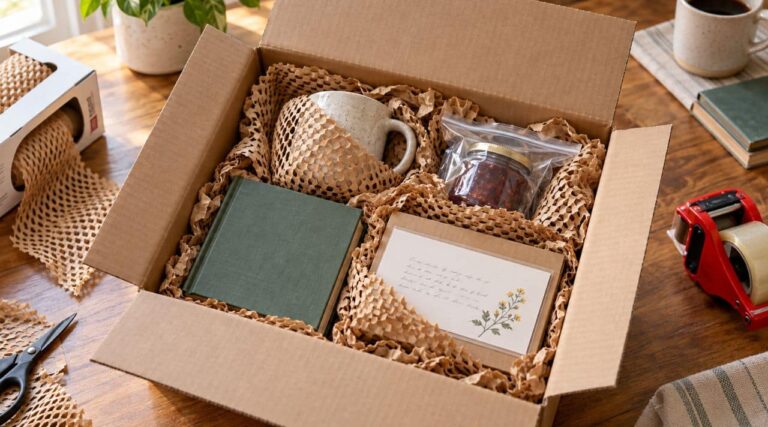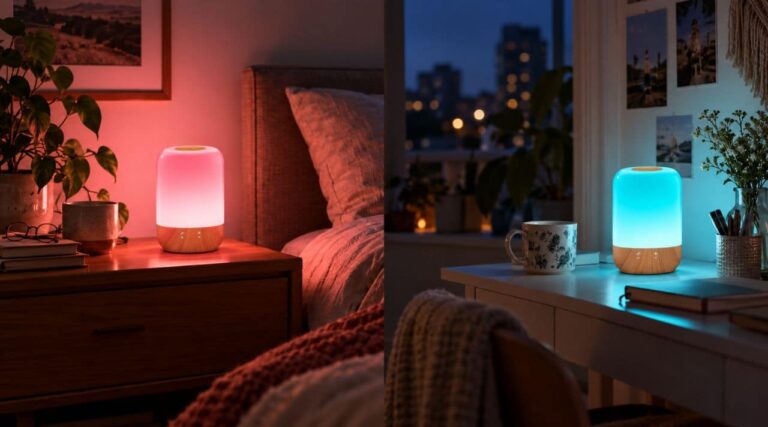


A personal care package is not the fullest box. It is the one that could only have been packed for this person.
When I picture someone far away opening a care package, I do not begin with tissue paper or a shopping list. I picture the hour in which the box will reach them: after a long shift, in a temporary room that still does not feel like home, or at a desk where they have eaten dinner three nights in a row. That moment tells me more than a list of popular care-package ideas ever could.
A useful box usually needs only four things: something that sounds like you, something familiar they can enjoy, something useful for the week they are having, and one small invitation to a future moment together. None has to be expensive. The work is in choosing honestly – and leaving out anything that asks the recipient to pretend it suits them.
The four-part care-package formula
The box does not need all four parts in equal measure. If one personal note and two useful things are enough, stop there.
Decide what belongs before shopping
Before buying anything, finish one honest sentence: “This week, they could probably use…” The answer might be a taste of home, a small convenience, something to do on a quiet evening, or simply proof that somebody remembered a detail they mentioned.
If the sentence stays vague – “They might like something cozy” – the item is still a guess.
- Do I know they like or need it?
Use a preference they expressed, a routine you have seen, or a need they mentioned. Do not turn a care package into a personality test.
- Can they use it without making room for it?
Consumables, refills and compact objects suit someone in a dorm, shared home, temporary apartment or small room.
- Can it survive the journey?
Consider heat, cold, delay, leakage and crushing before choosing food, liquids or fragile objects.
- Will they understand why it is here?
If the reason is not obvious, add one plain sentence. Meaning should not require the recipient to solve a riddle.
A care package feels personal because its contents fit one person’s present life – not because every empty corner has been filled.
If the person is grieving or moving through another difficult stretch, the purpose changes. A supportive care package should be easy to receive, useful without explanation, and free from pressure to respond.
Choose one item for each useful role
Begin with a personal anchor
A personal anchor tells the recipient, “I was thinking about you – not about the category called long-distance gifts.”
It can be a printed photo with a date on the back, a postcard from a place you both know, a recipe with one handwritten correction, or a short letter that mentions something real.

A shared photo works best when it brings back one specific moment rather than trying to summarize the whole relationship. Print just one, then write the date, place, or small detail that only the two of you would recognize on the back.
“Open when” letters work best when the prompts come from the person’s actual life. “Open after your first week at the new job” is more believable than a stack of generic emotions copied from a printable.
Two or three envelopes are enough. Twenty can quietly turn affection into homework.
Add a familiar comfort they already choose
This is the place for their usual tea, a regional snack they miss, the coffee they buy when they can find it, or soft socks in the style they already wear. Send a small amount unless you know they want more.
A modest favorite is useful; a family-size supply of the wrong flavor becomes a storage problem with a ribbon around it.
Check allergies, dietary restrictions and scent preferences rather than guessing. If chocolate may sit in summer heat or homemade food may spend days in transit, choose something shelf-stable instead. The comfort should survive long enough to be comforting.
Solve one small problem in the week ahead
Think about what they are doing, not what care packages are supposed to contain. Someone starting a course may use the exact pen refill they prefer.
A friend working late may appreciate a familiar snack that fits in a desk drawer. A person settling into a new room might welcome a compact cable organizer or a small supply they said they could not find locally.

When someone is still settling into a new room, keeping chargers in one known place removes a small daily nuisance. Use one elastic loop for each cable rather than coiling several together, so the needed cord can be taken out without disturbing everything else.
Specificity matters. “Stationery” is broad; a refill for the pen already in their bag has a known purpose.
“Self-care” is broad; an unscented eye mask makes sense only if they already use one or mentioned difficulty sleeping. Choose one solved problem rather than an assortment of imagined needs.
A small shared activity can give your next conversation somewhere easy to begin. Send two copies of a short puzzle and keep one. Include a simple recipe each of you can make on different days. Add a tea bag for a call that is already part of your routine.
You can also add a shared ritual to the box when it fits how the two of you naturally stay in touch.
Do not ask for a photograph, a scheduled unboxing or proof that the activity was completed. If their week becomes crowded, the gift should still feel generous when they use it alone – or leave it for another day.
Make ordinary contents feel personal
Place a small note beside the item
A packet of biscuits becomes personal when the note says, “You bought these on our rainy walk and complained that I ate most of them.”
A notebook becomes specific when you write, “You said you needed somewhere to keep the strange phrases your students use.” The sentence does not need to be beautiful. It needs to be true.
Write one note for the whole box
-
Name what made you think of them
Begin with a routine, memory or detail they mentioned: “I remembered…” or “You told me…”
-
Explain one or two choices
Say, “I included this because…” The reason can be practical, funny or small. Not every item needs to become a symbol.
-
Remove the obligation
End without asking for a photo, immediate call or detailed thank-you. “No need to reply quickly; I just wanted this to reach you” is enough.
Write as you normally speak. Replace any sentence that sounds borrowed from a greeting card.
Leave out the wrong kind of generosity
Skip preferences you do not actually know
- Perfume, candles and scented body products when you do not know the fragrance they use or whether scents bother them.
- Clothing in an uncertain size, especially when returning it from another city or country would be awkward.
- Hobby supplies chosen from appearance alone; materials, sizes and compatibility matter.
- Decorative keepsakes without a known place, particularly for someone living temporarily or sharing a small room.
Skip items that travel badly
Leave out food that spoils quickly, containers likely to leak, fragile objects that require heroic packing, and anything the carrier or destination does not accept. Rules vary by carrier and country.
For parcels sent internationally from the United States, the USPS international restrictions page lists prohibited and restricted categories, but the destination country’s conditions still need checking.
Keep this check brief here. The separate article on packing and mailing a care package safely covers protection, carrier preparation and shipping in greater detail.
Edit and pack the finished box
- Lay everything out
Remove anything included only because the box looked empty. A smaller box is allowed.
- Check the four roles
The contents should offer connection, familiarity, present usefulness or a future shared moment. One item may do two jobs.
- Separate vulnerable contents
Seal liquids individually, keep weight away from crushable items and cushion fragile edges. Leave out anything you cannot protect confidently.
- Close the box without taping it
Lift it and move it gently. If objects slide or knock together, add cushioning or remove something before sealing.
- Read the note once more
Make sure it sounds like you and does not demand a quick reply, photograph or scheduled call.
If mailing the box is too costly or impractical, send the note with one flat item—or send the note alone. The personal detail is not measured by parcel size.
When packing and mailing it yourself is too slow, costly, or impractical, compare care-package delivery options instead. The same four-part formula still applies; a seller should not decide what feels personal on your behalf.
A personal care package does not have to prove how much you miss someone. It only has to enter one ordinary part of their life with care. Choose a familiar detail, solve one small problem, leave room for a future moment, and explain the choices in your own words. If the box begins to feel crowded, take something out. The recipient should recognize themselves in it – not your fear that you have not sent enough. For ideas beyond a parcel, visit the long-distance gifting guide.