


Sometimes the object is wrong for you even though the kindness was not.
An unopened candle sits behind the towels. A second coffee grinder waits in its box. A beautiful scarf is still folded exactly as it arrived because the colour has never felt like yours. Each time you see the gift, you remember the person who gave it – and feel slightly guilty for not becoming the person who would use it.
That guilt does not mean you are ungrateful. A present can miss for ordinary reasons: you already own one, the scent gives you a headache, your home has no room, or the item would suit somebody else far better. Keeping it untouched does not preserve the giver’s thought. It preserves an object and a small burden beside it.
Regifting means giving an unused present you received to another person. Done carelessly, it can hurt. Done thoughtfully, it can put a good object into the hands of someone who will actually enjoy it.
Is it okay to regift a present?
Regifting is not inherently rude. It becomes inconsiderate when a worn, unsuitable, or emotionally meaningful item is passed along merely to empty a cupboard. A considerate regift is unused, complete, safe to give, and chosen for a specific person who would genuinely welcome it.
The history of an object does not automatically make it inferior. Plenty of gifts are bought months before they are given, stored in shops, returned unopened, or exchanged for a better fit.
What matters is whether the next recipient receives something that feels properly chosen – not somebody else’s problem in fresh wrapping.
I also think the original giver deserves care. Their intention mattered even when the item did not work for me. The wider etiquette behind an awkward gift decision begins there: protect the person where you reasonably can, without pretending every object must remain in your home forever.
Etiquette expert Pattie Ehsaei offers a useful second opinion on what separates a thoughtful regift from an awkward handoff.
Her advice reinforces the central point: the item’s condition matters, but the recipient, timing, and social circle matter just as much.
A regift starts with one person in mind. Decluttering starts with an object you want gone. The same unopened candle can be thoughtful in the first situation and careless in the second.
Four conditions make a regift considerate
| Check | A comfortable yes | A reason to stop |
|---|---|---|
| Condition | Unused, clean, complete, current, and ready to give | Used, sampled, damaged, expired, dusty, or missing parts |
| Recipient | You can explain exactly why it suits this person | “I need this out of my house” is the main reason |
| Meaning | Generic enough to move without breaking a personal promise | Handmade, engraved, heirloom, or tied to a shared memory |
| Social distance | The giver and recipient are unlikely to compare notes | They share family, friends, coworkers, or regular gatherings |
The item must still be gift-ready
Check the item the way you would inspect something bought from a shop: seals intact where hygiene matters, every attachment present, packaging clean, instructions included, and use-by dates comfortably ahead.
Opening a box to see what is inside does not necessarily ruin a gift. Using, sampling, washing, wearing, or testing the item often does.
A quick apology in your head is useful evidence. Thoughts such as “the dent is hardly visible” or “they probably will not notice the missing cable” usually mean the item is no longer suitable for regifting.
The recipient must be more than a convenient occasion
Think about the person’s taste, space, diet, routines, and what they already own. A duplicate cookbook may delight a cousin who cooks from that cuisine every weekend. The same book is not a meaningful present for the next person whose birthday appears on the calendar.
Selective recipients are sometimes easier to shop for when they are allowed to say what would be useful. There is nothing impersonal about asking what kind of gift they would actually want rather than passing along another guess.
The original giver’s sister, close friend, colleague, or neighbor is usually too near. People mention gifts. Photographs appear online. The recipient may bring the item to a gathering where its history becomes obvious. Nobody has done anything terrible, yet everyone suddenly wants to study the ceiling.
Distance helps: a generic desk accessory from one workplace may suit someone in a different company; unopened tea from a neighbor may please a relative who lives elsewhere. Expensive, distinctive, or highly memorable gifts need much more caution because they are easier to recognize.

What can – and should not – be regifted
Food, beauty products, candles, and fragrance
Unopened tea, coffee, biscuits, preserves, or a pantry gift can work when the date is clear, storage has been proper, and the ingredients remain readable. Leave a comfortable margin before expiration; handing someone food they must finish by Thursday is less a gift than an assignment.
Beauty and self-care products need intact seals and stable texture, color, and scent. Skip opened makeup, used applicators, leaking bottles, or products kept in heat.
Strong fragrance also requires a recipient whose preference you actually know. “Most people like vanilla” is how cupboards acquire their second unopened candle.
Books, home goods, toys, and duplicate gifts
A pristine book, unopened game, unused kitchen tool, picture frame, serving piece, or duplicate household item may travel well. Look inside books for inscriptions and bookmarks.
Count game pieces, check battery compartments, find the manual, and make sure the “duplicate” was not put aside because it was faulty or irritating to use.
Packaging does not have to be flawless, but the gift should not arrive looking rescued. A torn retail box may be fine when you tell a close friend plainly that the item itself is new; it is a poor foundation for pretending you selected a pristine birthday present.
Handmade, personalized, and sentimental gifts
A monogram, dedication, family story, handmade detail, or shared joke can make an item unsuitable for ordinary regifting. The object may have taken hours to make even though it cost little. Passing it off as a gift you chose for someone else quietly erases that care.
This does not mean every sentimental object must stay forever. Keeping it for a time, returning it privately where that makes sense, offering it back to family, repurposing materials, or donating it discreetly may all be kinder.
Heirlooms and gifts connected to someone who has died deserve their own conversation, not a quick place in the donation bag.
Can you regift a gift card?
Check that the value is still usable
- Verify the balance through the retailer’s official website or phone number.
- Check expiration dates, inactivity fees, regional limits, and participating locations.
- Make sure the card has not been registered or added to your own account.
- Inspect the PIN covering and packaging for signs of tampering.
Match the store to the person
A restaurant card is not useful to someone who lives far from every location. A clothing card still assumes taste, sizing, and access.
A large amount can also feel disproportionate in a casual relationship. The safest gift card is not necessarily the most flexible-looking one; it is the one connected to something you already know the person uses.
Never guess at the remaining value or disguise a partly used card as whole. A low balance can still be passed along informally – “I have $12 left here and thought you might use it” – but that is sharing, not presenting it as a new gift.
Regifting at Christmas, Secret Santa, and other exchanges
Secret Santa still calls for a person-specific choice
A regift can fit Secret Santa when it meets the agreed budget, remains new, and suits the person whose name you drew.
Keep it out of the same group in which you originally received it. A colleague remembering the box from last year can turn a harmless shortcut into the only story anyone tells over lunch.
White Elephant allows more play – but not rubbish
Some White Elephant exchanges invite odd, funny, or previously owned objects. Follow the group’s stated rules. “Silly” does not mean broken, dirty, offensive, or impossible to take home.
A strange but functional object may make the game fun; a damaged appliance simply transfers disposal work to another person.
Family traditions need special care
Families are often the riskiest place to regift because stories travel quickly and gifts reappear in photographs or homes.
An agreement to exchange consumables, use wish lists, set a small limit, or stop adult presents may prevent the annual migration of unwanted objects. Sometimes opting out of a gift exchange is entirely reasonable.
How to regift without making it feel second-best
- Inspect it in good light
Check every surface, seal, page, date, accessory, and compartment. Remove the item from consideration when its condition needs an excuse.
- Remove the old trail
Look for cards, gift receipts, shipping labels, handwriting, price stickers, inscriptions, and names tucked inside the packaging. Keep useful manuals and warranty information.
- Prepare it for this recipient
Use clean wrapping suited to the occasion and add a note written for the new recipient. Fresh presentation should express care, not disguise damage or a poor match.
- Say why it suits them
A simple sentence is enough: “This made me think of your Sunday baking,” or “I remembered how much you enjoyed that author.” Keep the focus on the real connection.
- Stay truthful when asked
There is no need to announce the item’s history as though it were a defect. A direct question deserves a direct answer: “It was given to me, and I realized it would suit you much better.” Never invent a story about buying it.
A new ribbon can make a suitable gift feel cared for. It cannot make an unsuitable gift suitable.
Sometimes another choice is kinder
Return or exchange while the option is still open
A gift receipt exists for exactly this problem. Exchanging a color, size, duplicate, or unsuitable scent is not an insult. It allows the giver’s money to become something useful.
Returning a gift becomes bad manners mainly when it is done with contempt, used to demand cash from the giver, or discussed in a way meant to embarrass them.
Sealed food can be shared when ingredients and allergens are visible. New toiletries, toys, clothing, and household goods may suit a charity, but check its current acceptance list first.
Used cosmetics, expired food, unsafe electronics, and incomplete items usually belong in an appropriate recycling or disposal route.
Change the next exchange before the cupboard fills again
A wish list, consumables-only agreement, shared meal, experience, or no-gift arrangement can take pressure off everyone.
When somebody has already said “no gifts, please,” respecting that request is more thoughtful than searching for an object small enough to slip past the boundary.
Declining a present at the door can sometimes feel harsher than accepting it warmly and deciding later what to do. Safety, ethics, workplace rules, or a clearly stated boundary may require an immediate refusal.
Ordinary mismatches rarely need a dramatic scene. Gratitude belongs to the gesture; permanent ownership of the object is a separate question.
The final decision: regift, exchange, donate, or keep?
| What you have | Best next step |
|---|---|
| New, complete, impersonal, and ideal for one person outside the giver’s circle | Regift |
| Wrong size, color, scent, or duplicate with a valid return option | Exchange |
| New and useful, but no suitable personal recipient | Donate |
| Sealed food with clear ingredients and a sensible date | Share or regift |
| Handmade, personalized, or emotionally significant | Keep, return privately, or handle with special care |
| Used, unsafe, expired, damaged, or incomplete | Recycle or dispose responsibly – do not regift |
The simplest test is not “Can I get away with this?” It is “Would I feel cared for receiving this exact item, in this exact condition, from this person?” A comfortable yes usually means the gift can move on. A long internal argument usually means it should not.
You are allowed to appreciate the person who gave something without keeping the thing forever. Gratitude does not need a permanent address in the back of a cupboard.

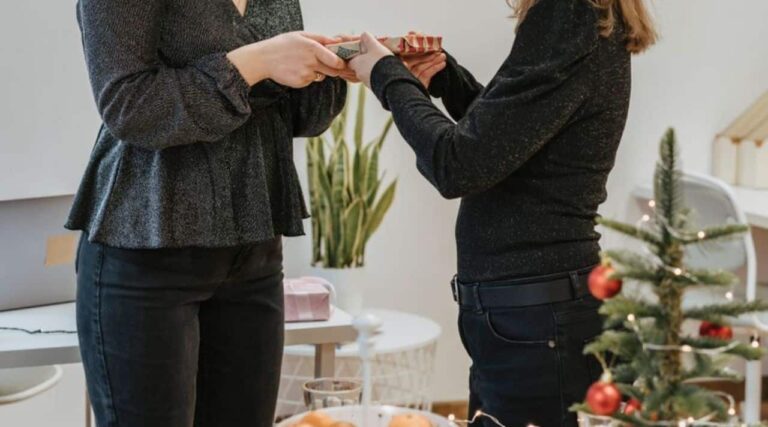


The two social circles need some distance