

There may already be a gift on your bookshelf: the novel a friend picked up during a visit and said they would like to read.
Or it may be in your phone, among photos from an afternoon you both still talk about. Neither needs a shopping trip. Both need a little attention before they are ready to give.
Gift ideas using things you have begin with that connection. The useful question is not “What can I get rid of?”
It is “What do I own that this person would enjoy, use, or be glad to remember?” That changes the search from a cupboard clear-out into choosing a gift.
Below are six starting points, with examples of how to finish them. Use the one that matches both your supplies and the person.
If an idea sends you shopping for a printer, special jars, or a new craft kit, choose another. The point is to make something ready to receive with what is already within reach.
A book they have already shown interest in

A book is a promising gift when someone has asked about your copy, enjoys the author, or wants to explore its subject. “You mentioned wanting to read this” gives the choice a reason. “I have finished it” only tells them why it is leaving your shelf.
Check the cover, pages, and binding. Remove receipts, private notes, and anything you used as a bookmark.
Leave the book as it is rather than trying to disguise its age; the condition of a secondhand gift matters more than making it appear newly bought.
Then tuck in a loose note. Here is an example for a friend who asked for a lighter mystery:
“You mentioned wanting a mystery that isn’t too grim. This is my copy, and I thought you might enjoy it. It’s yours to keep or pass on when you’re done.”
That last sentence resolves the borrowing question and gives them freedom over the book. A ribbon is optional. A clean paper bag works too. Neither needs to hide that this is your own copy.
If there are pencil notes or a noticeable mark, mention them plainly. Skip books with missing pages, damp damage, or strong odors.
And choose another idea if the person does not read or already owns the title. A beautiful message cannot fix the wrong book.
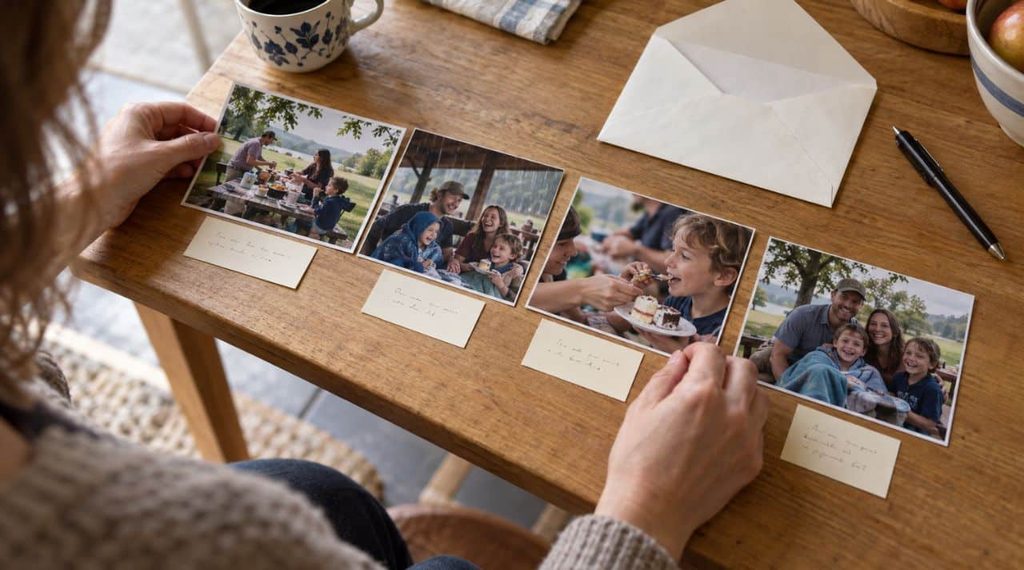
A few photos with the story written beside them
A photo gift becomes more interesting when you add what the camera missed. Instead of forwarding a hundred pictures, choose a handful from one occasion.
Put them in order, identify people where helpful, and explain the details that would otherwise disappear.
For a hypothetical family picnic, the captions might look like this:
| Photo | A caption that brings the day back |
|---|---|
| Everyone setting out the food | “Before the wind arrived. We were still convinced the paper plates were a sensible idea.” |
| The group gathered under a shelter | “Ten minutes later, we moved everything here. This is why nobody looks especially dry.” |
| Two people laughing over the last piece of cake | “The cake survived. The argument about who deserved the last piece did not.” |
The wording does not need to be funny. A name, an approximate date, and one true detail can be enough. Write what you actually know; an uncertain year can remain approximate.
Use existing prints when you have them
Slip a few prints into a clean envelope with their notes, or use an album you can spare. If you own an unused frame and know they would welcome it, frame one photo and attach the story to the back.
There is no need to buy a frame simply because the idea began with a photograph.
Make digital copies before giving away your only originals. Avoid trimming or gluing irreplaceable photos for the sake of a layout. A neatly gathered set is a finished gift even without scissors and a decorative border.
Make a small digital album when printing would cost more
When your pictures are on your phone, use an album or document tool you already have. Arrange the photos, add their captions, and open the result once to check that it reads well.
Send a file or private link the recipient can use without paying for an app.
Keep private or potentially embarrassing images out unless sharing them is welcome. Someone can love a photograph and still dislike finding it on social media. The gift can stay between the people it was meant for.
If a friend always asks how you make one particular dish, the recipe can be the gift. You do not need to buy a recipe box, bake a batch, or produce a family cookbook. One page they can use is enough.
Write the recipe for someone who has not watched you cook. Include ingredient quantities, the number of servings, useful pan or equipment details, the order of the steps, and how to judge the result. Separate your optional changes from the main method.
Even a very small recipe can have a complete, readable card. This simple example shows the format; for your gift, use the recipe the person actually requested:
Makes: one small batch.
Ingredients: 2 tablespoons granulated sugar; ½ teaspoon ground cinnamon.
- Put the sugar and cinnamon in a small, dry bowl.
- Stir until the cinnamon is evenly mixed through the sugar.
- Sprinkle a little over buttered toast to taste.
Storage: Keep the dry mixture in a clean, dry, closed container.
Your note: “For the toast you asked about. I use this cinnamon-to-sugar ratio; you can adjust it to your taste.”
For a more involved dish, the valuable addition may be a note about when to drain an ingredient, what can be prepared ahead, or which substitutions you have successfully used.
These are the details a person normally learns while standing beside you in the kitchen.
If you know the recipe’s history, add it. If you do not, the dish does not need an invented grandmother to make it meaningful. The fact that this person asked for your version is already a connection.
A small batch of a treat they enjoy
For someone who likes your baking, a modest amount of a familiar favorite can make more sense than a large hamper.
Start with the ingredients you own, then choose a recipe you already know how to make. Novelty is optional; a reliable favorite is a good place to begin.
Imagine you have the ingredients for the cookies a friend enjoyed last time they visited, and a clean food-safe tin.
You can give a small batch with a label explaining what is inside, when it was made, and how it should be stored. The gift is complete without special jars or matching printed labels.
Name the food, list the ingredients, add the preparation date, and give storage instructions appropriate to the recipe. Ask about dietary needs before cooking. Do not describe the food as allergen-free unless you can substantiate that.
Choose a container suitable for food contact. A reused jar with a tight lid does not make its contents shelf-stable.
For perishable food, USDA food-safety guidance calls for refrigeration within two hours, or one hour above 90°F (32°C). Keep it cold during transport when required, including the handoff.
Skip this idea if dietary needs, safe storage, or delivery are uncertain. Giving the written recipe may be easier.
And if you need several purchases to complete the project, whether handmade gifts cost less becomes a different question from using what you have today.
A rooted plant from one you already own
This is a lovely possibility for someone who has admired your plant and would like one – not simply someone who has an empty windowsill. Ask first. A plant adds care to their week as well as greenery to their room.
If you already have a healthy rooted plant to spare, use a suitable pot you own and attach its name and basic care information. Here is an example of an offer rather than an unexpected responsibility:
“You asked about the plant by my window. I have a rooted one to spare – would you like it? No problem if you don’t have room.”
If you need to start with a cutting, prepare ahead and identify the plant before choosing a method. Iowa State’s propagation guidance explains that different species need different types of cuttings. Not every plant can be treated the same way.
Check the intended growing conditions and any concerns about pets or children for that species.
Do not guess its identity or hand over an unrooted cutting as though it were an established plant. If the birthday is tomorrow and nothing is ready, choose one of the other ideas.
A small bundle for a hobby they already practise
Useful materials can be a gift without becoming a new craft project for you. Clean fabric, spare yarn, or good paper may suit someone who already works with them.
The important part is knowing what they use, then making the bundle easy to understand.
For a friend who makes small patchwork pieces, coordinated fabric offcuts could be useful. Fold the clean pieces together, measure their usable dimensions, and note the fibre content if you know it.
Ask about their work first: the same small pieces may be unhelpful to someone sewing a full-size garment.
- Fabric: Include usable dimensions and fibre content when known.
- Yarn: Keep the original label where available; do not guess the fibre or quantity.
- Paper: Say what kind it is when known, and keep sheets clean, flat, and usable.
The accompanying message can explain the fit: “You mentioned needing small blue pieces for your patchwork. Would these sizes be useful?” That gives the person a chance to decide before receiving a bag they must sort.
Blunt tools, tangled remnants, and an unfinished project you no longer want are different.
Leave them out. If they already have more than enough supplies, choosing gifts for someone who has everything calls for a different kind of attention, not a bigger bundle.
Let the wrapping protect the gift, and the note explain it
Once the gift is ready, use clean packaging that suits it: a bag for the book, an envelope for photos, or a sturdy box with padding for something fragile.
Remove old shipping labels and private information. There are plenty of ways to wrap gifts with less waste; this one does not need to become a second project.
At the handoff, explain the connection instead of apologizing for the budget. “You asked for this recipe,” “I added the details to these photos,” or “I thought this copy might be your next read” tells them why you chose it. Be honest that an item is previously owned.
If nothing at home suits the person, a no-spend gesture of care may be kinder than an unwanted object. The cupboard does not have to produce a present just because you opened it.
That is the useful thread through giving meaningfully on a budget: choose a real connection, finish the gift, and leave the recipient free to enjoy it.
Gift ideas using things you have can be modest and still feel considered. You are giving attention along with the thing.